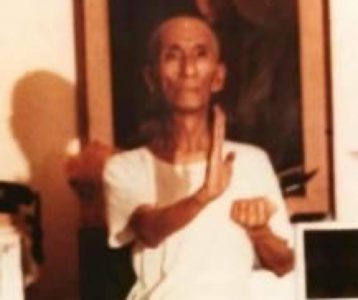
What It Is
Wu Sao — “guarding hand” or “protecting hand” — is the secondary hand position held while the lead hand is engaged. The palm faces forward, fingers relaxed, positioned to cover the centreline and ready to respond if the lead hand’s position fails or an attack arrives from an unexpected angle.
It appears constantly throughout Sil Lim Tao and every subsequent form, almost always as the “other hand” while the named technique happens elsewhere. Because it’s rarely the headline action, it’s also the technique most students stop paying attention to first.
The Forgotten Hand
Watch intermediate students in Chi Sao and you’ll often see their Wu Sao drift — dropping low, drifting wide, or going completely passive while all their attention focuses on the active hand. The moment that happens, the centreline they thought they were protecting has a hole in it.
Wu Sao’s job is genuinely boring most of the time, which is exactly why it gets neglected. But “boring and present” is the entire value proposition. A Wu Sao that’s actually covering the centre turns a percentage of incoming attacks into non-events before they become problems requiring a conscious response.
From Guard to Action
Wu Sao isn’t purely passive. It’s positioned to transition immediately into Tan Sao, Bong Sao, Pak Sao, or a strike, depending on what arrives. The hand shape itself is close to neutral — soft, slightly forward, fingers loose — specifically so it can become almost anything without a large structural change first.
This is worth drilling deliberately: from a static Wu Sao position, have a partner attack from various angles and practise letting Wu Sao become the appropriate response without first “resetting” into some other shape. The transition should feel immediate, not sequential.
Why It Rates Lower on Depth
Compared to something like Bong Sao or Chi Sao, Wu Sao doesn’t have layers of advanced application waiting to be discovered. Its value is almost entirely in consistency — being there, every time, without exception. That makes it less interesting to study but arguably more important to actually maintain in live practice.
Wu Sao as a Diagnostic Tool
One of the ways I use Wu Sao in my own training is as a diagnostic for where my attention is going. If I watch video of myself drilling or sparring and my Wu Sao is drifting, it tells me exactly where my focus broke down. The hand goes where the attention is — and when Wu Sao drifts, the attention is entirely on the active hand, which means the whole defensive structure has narrowed to one point.
This is why I insist my students develop the habit of Wu Sao as a background process rather than a conscious choice. You shouldn't have to think "Wu Sao now." It should be the default state of the non-active hand, maintained automatically while everything else is happening.
The Height Question
Where exactly should Wu Sao sit? There's genuine variation between lineages, but the functional answer is: wherever it needs to be to cover the centreline given the position of the active hand. If your Tan Sao is extended forward and high, Wu Sao needs to be positioned to cover the inside gate that Tan Sao has opened. If you're in Bong Sao, Wu Sao should be ready to follow the redirect with a strike.
The mistake is treating Wu Sao as a fixed position rather than a responsive one. It moves relative to the active hand, not in isolation.
Wu Sao in Applications
In self-defense applications, Wu Sao is often the hand that delivers the counter-attack. The lead hand redirects or deflects; Wu Sao — already positioned on the centreline — drives forward while the opponent is still processing the redirection of their attack. This is the simultaneous attack-defense principle Wing Chun is built on, and Wu Sao's pre-positioning is what makes it possible.
The student who thinks of Wu Sao as purely defensive is missing half the picture. It's not the guarding hand that never strikes. It's the loaded hand that can become anything the moment the lead hand creates an opening.
Maintaining It Under Fatigue
Wu Sao maintenance under fatigue is a real training goal that doesn't get enough attention. When you're tired, the non-active hand drops first. It's the brain's way of conserving effort. Building the habit of maintaining Wu Sao position even when the rest of your technique is under pressure from fatigue requires deliberate, extended drilling — not just short technical practice.
Kendra’s Verdict
Wu Sao won’t teach you much by itself, but its absence will teach your opponent everything. Treat it as a discipline issue rather than a technique to master — the goal is simply to never forget it’s there.