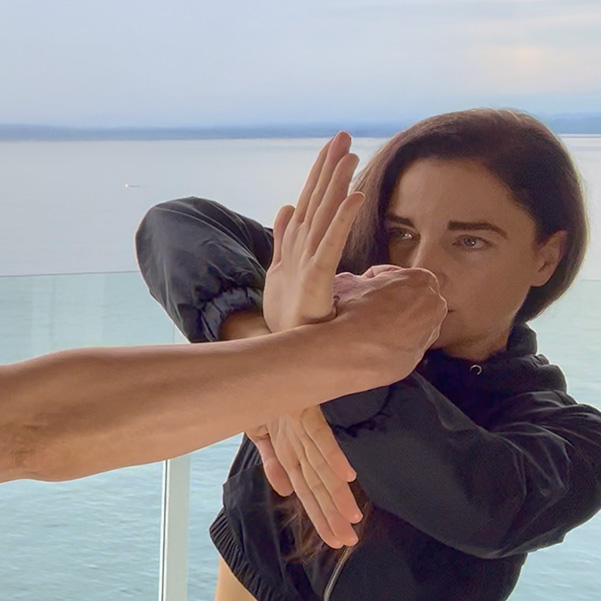
What It Is
Bong Sao — the “wing arm” — is one of the three primary arm shapes in Wing Chun, alongside Tan Sao and Fook Sao. The elbow rises, the wrist drops, and the forearm angles upward like a deflecting ramp. It redirects incoming force to the outside rather than meeting it head-on.
On paper, the mechanics are elegant. In practice, the margin between a Bong Sao that redirects cleanly and one that collapses under pressure is razor thin — and it took years to understand why.
The Structure Problem
Most beginners make Bong Sao a shoulder movement. You lift the elbow because that’s the most visible part of the shape. The problem is that a raised elbow with a tense shoulder is structurally empty — it has no connection to your centre and will crumble the moment someone pushes into it with intent.
The elbow rises as a result of the wrist dropping and the forearm angle finding its position relative to the centre line. That relationship — elbow to wrist to centre — is where the strength comes from. Not the shoulder. Once that clicked, Bong Sao became a completely different tool.
Chi Sao Context
Where Bong Sao really gets tested is in Chi Sao. In rolling hands, you’ll be pressured into Bong Sao when your Fook Sao gets over-committed or when someone attacks your inside gate. A well-formed Bong Sao in Chi Sao doesn’t feel like a rescue — it feels like a redirect that immediately opens a counter-attack pathway.
If your Bong Sao in Chi Sao feels like you’re hanging on for dear life, the structure isn’t there yet. Keep working it.
Where It Falls Short
Bong Sao is a high-elbow technique, which makes it vulnerable if someone understands that. A smart opponent can press the elbow down and nullify it entirely. It’s also deeply contextual — Bong Sao works when the geometry is right. Against a low attack or from a non-standard angle, you’re reaching for a different tool.
There’s also a lineage variation issue. The interpretation of Bong Sao varies enough between Wing Chun branches to create real confusion when you change training partners. Know your version and understand why.
The Lineage Variation Problem
One thing that trips up practitioners who cross-train or change schools is that Bong Sao looks meaningfully different depending on which lineage you're in. The elbow height, the wrist angle, the degree of rotation through the forearm — these all vary between branches. This isn't corruption of the original; it reflects genuine interpretive differences that developed as the system spread globally.
What matters is that your version has structural integrity — that the relationship between elbow, wrist, and centreline creates actual deflective capability rather than just the right visual shape. If you can't feel what your Bong Sao is doing under pressure, it doesn't matter how correctly it photographs.
Drilling Bong Sao Effectively
The most useful drill for developing real Bong Sao structure is to have a partner apply steady, increasing forward pressure while you hold the position. Don't move yet — just feel where the pressure wants to collapse it. Usually it's the elbow folding inward or the shoulder rising to compensate. Identify which, then address that specific problem.
Once you can hold structure under steady pressure, add movement: deflect the incoming pressure to the outside and immediately follow with a counterstrike. Bong Sao without an immediate transition is a pause, not a technique. Wing Chun doesn't have pauses.
Common Errors After Years of Training
Here's something I rarely see discussed: Bong Sao errors in experienced practitioners are different from beginner errors. Beginners lift the elbow with the shoulder. Experienced students often over-correct — they become so focused on elbow-wrist relationship that they lose centreline connection entirely. The arm becomes technically correct in isolation but functionally disconnected from the body behind it.
The correction is always the same: return attention to the centre. Every technique in Wing Chun is an expression of the centreline, not a standalone arm movement. Bong Sao is no exception.
Kendra’s Verdict
Bong Sao is genuinely sophisticated and genuinely hard to do well. Worth the investment — but don’t let it become your go-to shape because it looks good in photos. Earn it in rolling hands first.